
Welcome, or welcome back, to Jewsrock.org.
In the early 2000s, David Segal, a music critic at the Washington Post who now writes for The New York Times, and Jeffrey Goldberg, then at The New Yorker and now the Editor-in-Chief of The Atlantic, asked their talented writer friends to contribute essays to an archive that would detail the Jewish contribution to popular music — specifically Rock and Roll.
The idea started with a 2001 interview David did with Scott Ian of Anthrax — born Scott Rosenberg — during the anthrax scare, natch, when he thought about the number of rock and rollers who grew up going to Hebrew school.
Perhaps the bigger mission, beyond answering “Billy Joel: Jew or not a Jew?", was to provide a cultural touchstone — to give Jews a source of pride in the outsized role our Tribe played in creating the soundtrack to everyone's lives.
This earnestness could have been viewed as almost naive back in 2005, when the collection of essays was first published online as the Jewish Rock and Roll Hall of Fame. Twenty years later, the need for this exercise in cultural connection is not a “nice to have.” It is a necessity.
For two decades, great writing sat buried.
Around the original launch, we were attacked on a number of fronts that we didn’t see coming. The very name of the enterprise, the Jewish Rock and Roll Hall of Fame, became an existential crisis: each of us was sued for $100,000 for trademark infringement, and then the website was overwhelmed by malware making it inaccessible.
The lawsuit
We innocently called it the Jewish Rock and Roll Hall of Fame. Had we run a trademark search first, maybe we wouldn't have crossed the machers in Cleveland—with their grandiose $100M I. M. Pei–designed temple. Not quite the spirit of the Cavern Club, CBGB, or the Whiskey.
A little research would have unearthed that a few years before they came for us, the Rock and Roll Hall of Fame had sued a Cleveland photographer named Charles Gentile for trademark infringement, for selling a poster of the Rock Hall caught at sunset. Although they lost, it would have told us exactly what we were up against with the litigious Goliath on Lake Erie.
First they went after a guy named Gentile, and then they came for the Jews.
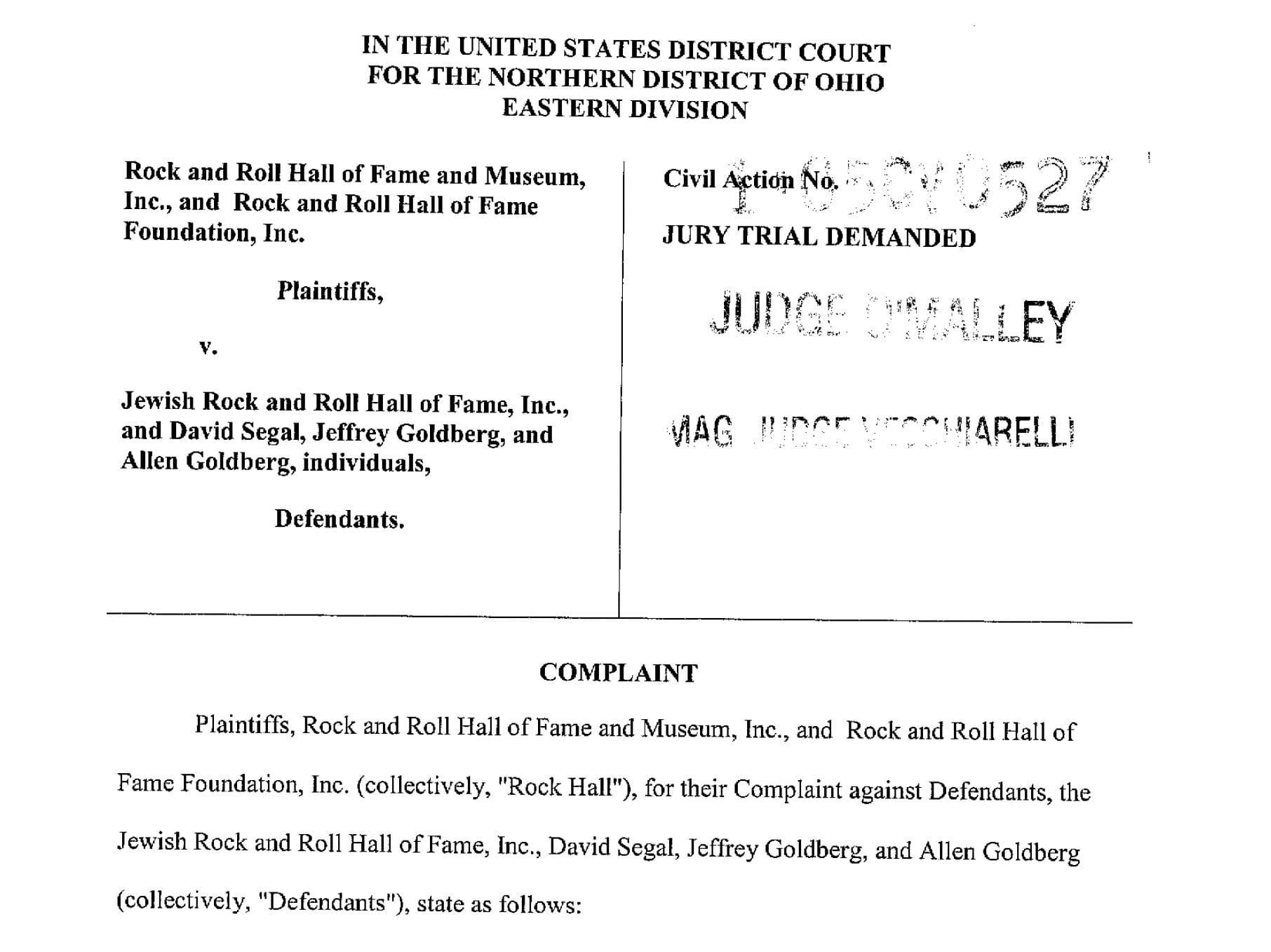
They sued us in federal court on the theory that people might confuse their institution with our modest operation running out of our basement. When word of the lawsuit got out — had they never heard the admonition not to pick fights with guys who buy ink by the barrel? — we were inundated with offers to help.
It seemed as if every Jewish intellectual-property (IP) lawyer in America emailed offering to represent us, pro bono. We were grateful to all of them, and we went with a friend.
Andy
Our lawyer was Andy Katz, z”l, an excellent IP attorney with a huge heart who loved music as much as anyone I’ve known. He had also been playing our game since the time he learned who was behind the makeup at his first 1970s concert — Kiss.
The irony was that had Cleveland simply asked nicely, we would have changed the name in a heartbeat. Violating their IP was an innocent mistake. But once they outed themselves as bullies, Andy’s commonsense counsel to us was to enjoy it, reap the PR benefits, and maybe cause them a bit of agita.
After what seemed like an appropriate amount of time for their white-shoe attorneys to be billing them at $800 an hour, we capitulated. Andy called their lawyers to say they’d won — we were renaming the enterprise “JewsRock.org.”
Andy died young on October 14, 2016. Every year his friends and family run as Team Rave On in the WXPN 5K to raise money for Musicians On Call, which brings live music to the bedsides of people in the hospital.
Henry
David and Jeffrey, besides being exceptional writers, are true mensches. At their direction, the original JewsRock.org was dedicated to the memory of my son, Henry Strongin Goldberg, z”l.
Henry was born in 1995 with a Jewish genetic disease, Fanconi anemia. As a little kid, he patiently sat through some of our earliest Jewish Rock and Roll organizing meetings at Firehook Bakery in the Cleveland Park neighborhood of Washington, D.C. He was a beautiful boy who lit up any room he entered — a friend once described it best, saying he had a smile bigger than his face.
At four years old, he was also a real music fan with excellent taste.
In the spring of 2000, our family drove 1,200 miles to Minneapolis for Henry to have a bone marrow transplant, and we made the trip on his music. One of the CDs on repeat in the minivan was by the Americana hero Todd Snider, and one of the songs was his “Beer Run” — a very funny tune about some frat boys in Texas trying to scrounge up “a ten and a five-er, a car and key and a sober driver.” Henry and his little brother Jack learned to spell off of it, hollering “B-E-E-R-R-U-N, beer run” alongside Todd from the back seat.
Another song on repeat that trip came from our neighbors to the north, Barenaked Ladies. We played “If I Had a Million Dollars” over and over — maybe that’s what taught the kids math, or how to dream. The band’s co-founder and lead vocalist, Steven Page, grew up Jewish in Toronto, and their album Barenaked for the Holidays includes the traditional songs “Hanukkah, Oh Hanukkah” and “I Have a Little Dreidel,” plus an original, “Hanukkah Blessings.”
I put all of these in rotation on Radio Hanukkah, back when I was the producer of that groundbreaking channel on XM Satellite Radio. Besides spinning the Hanukkah hits, Radio Hanukkah featured a JewsRock talk show with Jeffrey and David interviewing Jewish artists like Matisyahu and Kinky Friedman.
Todd
Henry’s mom, Laurie, later wrote a book about him — Saving Henry — and quoted “Beer Run” in it. Todd read the book and wrote to Laurie: “what a story, what a family, what a kid… and man oh man am i ever honored to have been in that car with y’all on the way up to minnesota… let me know if the cause ever needs a folk singer.” So we took him up on it, and Todd came and played a benefit concert in Washington, DC for the Hope for Henry Foundation, which Laurie and I started in Henry’s name to bring some normalcy and a little joy to seriously sick kids and their families.
Every cause needs a folk singer. And according to Laurie: "For one night, we had the best there was."
Todd Snider died in November 2025. He was 59.
Why now
We started JewsRock.org for a pretty simple reason: to give people — especially kids — a sense of connection to being Jewish. Something to feel good about. Inspiration.
That feels more important now than it did then.
So it’s back — the essays, the puns, the shtik, all of it. Big thanks to Izzy Grinspan who pulled together the A-Z Challah Fame and Kara Baskin who edited much of the original content. Before you roll your eyes about who isn't included in the Challah Fame or maybe some dated references, remember that this is being republished in its original 2004-2005 form.
Thanks for being here.
Allen Goldberg (no relation to Jeffrey — but in his words, “we’re all related”)